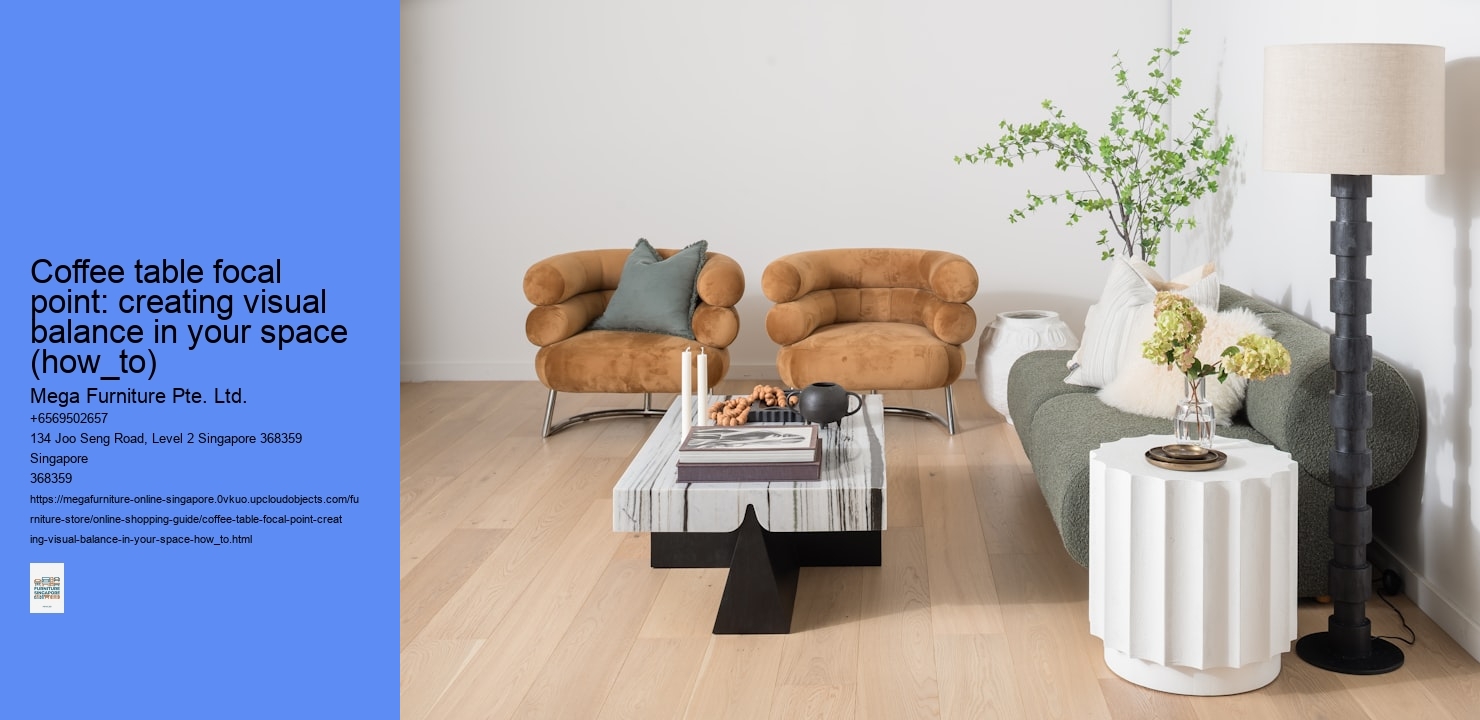
In many HDB layouts, the coffee table is the first thing your shins find in the dark. That’s its real role—not just a spot for your kopi, but a spatial traffic controller for the entire living zone. Get the proportions wrong, and a 120cm rectangular slab in a narrow BTO living room can force a single-file procession from the sofa to the dining area; it becomes an obstacle, not an anchor.
The typical dimensions here are a lesson in restraint. While a sprawling 150cm table might suit a landed property, it’s often a liability in a combined 12 sqm living and dining space. Heights between 38cm and 45cm work because they sit just below the sofa seat line, keeping sightlines clear and the room feeling airy. The shape is equally critical. A sharp-cornered rectangle demands precise navigation, whereas a round or oval design with a 90cm diameter subtly guides movement around its perimeter—there are no corners to catch a hip or a child’s sprint.
Material choice speaks to daily life, not just aesthetics. A solid rubberwood table can develop a patina from countless mug rings, which some homeowners cherish. For others, that’s a nightmare; they’ll prefer the wipe-clean indifference of sintered stone or tempered glass, surfaces that shrug off humidity and sticky fingers. The trend toward irregular, sculptural designs offers a clever compromise—these pieces act as visual art that occupies less physical footprint, tricking the eye into perceiving more floor space than actually exists.
Ultimately, the right coffee table organises the room’s rhythm. It should hold the essentials—a TV remote, a few magazines, a tray for drinks—without becoming a permanent landing strip for mail, school worksheets, and random chargers. That’s the chronic clutter issue in compact flats. Opting for a design with a shelf or integrated drawer, like some options in Megafurniture's collection, can be a tactical move, providing a hidden layer to stow the daily detritus and maintain that crucial sense of visual calm.
So, before you fall for a statement piece, tape its outline on your floor. Live with that phantom rectangle for a few days, and you’ll quickly learn if it’s a centrepiece or a congestion charge.
Place your coffee table at the center of your primary seating arrangement to establish it as the room's focal point. This creates a natural gathering spot and ensures visual weight is evenly distributed. The table should be within easy reach of every seat to promote both function and balanced sightlines.
Select a coffee table that is roughly two-thirds the length of your sofa to maintain proper scale. Its height should be level with or slightly lower than the seat cushions of your surrounding furniture. This proportional relationship prevents the table from appearing visually dwarfed or overwhelmingly large in the layout.
Maintain a minimum of 18 inches of clearance between the coffee table and other furniture like sofas and chairs. This space is crucial for comfortable legroom and ensures clear, navigable pathways around the seating area. Adequate clearance prevents a cramped feeling and contributes to a balanced, open atmosphere.
Anchor the coffee table visually by placing it on top of an area rug that also fits under the front legs of your seating. This technique layers the elements, connecting the table to the larger furniture grouping. It grounds the arrangement, adding texture and definition that enhances the overall sense of balance.
That faint, persistent cloudiness on the glass top of your old coffee table? It’s likely trapped moisture in the wood base, a common sight in humid flats from Pasir Ris to Clementi. Singapore’s climate, with its 80%+ humidity, demands a pragmatic eye for materials, especially for a piece that sees daily spills, wet-bottomed glasses, and the occasional exuberant pet. Solid wood, like teak or oak, offers undeniable warmth but requires vigilant sealing every year or so; skip that routine, and you’ll see warping or mildew in the seams. For a lower-maintenance route, engineered wood with a robust laminate top or sintered stone provides far better humidity resistance — they won’t swell or degrade with the seasonal damp, making them a sensible default for many households. The choice often comes down to whether you’re willing to trade the character of natural grain for the peace of mind of a virtually inert surface. Active homes with young children or pets introduce another layer of consideration. A sharp-edged glass top or a delicate marble lip becomes a genuine hazard in a cramped 4-room BTO living room where space is tight. Opt instead for tables with rounded corners, finished in a hardy powder-coated metal or a textured laminate that can withstand crayon marks, toy car collisions, and the general chaos of daily life. The goal is to find a centrepiece that endures, not one you’re constantly guarding. There’s a quiet satisfaction in choosing a table that looks good without coddling — one where a spilled *teh tarik* is just a quick wipe away, not a potential disaster. For a wide selection of options built with these practicalities in mind, from rounded metal frames to moisture-resistant engineered wood, you can
browse the collection. Ultimately, the best material is the one you stop worrying about after it’s delivered, letting it simply be the functional anchor your living room layout needs.
That awkward moment when your coffee table looks like a lost island in the middle of the room is usually a length issue. For the typical Singapore three-seater sofa, which spans 200 to 220 centimetres, your table should aim for roughly two-thirds of that width. That translates to a length between 130 and 150 centimetres, a proportion that visually anchors the seating arrangement without overwhelming it. Going significantly shorter makes the table feel like an afterthought, while matching the sofa's full width consumes precious floor space and disrupts the room's flow. This ratio is a reliable starting point, whether you're pairing with a modular sectional in a condo or a straightforward fabric sofa in a BTO. It's a simple calculation that prevents the most common sizing mistake right from the start.
Maintain 35 to 45 centimetres of air between your sofa's edge and the table. This isn't just a suggestion—it's the difference between comfortable lounging and constantly barking your shins. In a narrow 3.5-metre wide HDB living room, that buffer zone is non-negotiable; it's the corridor for people to pass and for you to stretch your legs after a long day. Skimping here forces a cramped, awkward posture every time you reach for your teacup, which defeats the entire purpose of a living room. That clearance also needs to account for any table overhang, like a cantilevered stone top, which can eat into the usable space. Get this wrong, and you'll feel it every single day.
The table's final dimensions aren't decided by the sofa alone—your room's floor plan has the ultimate say. A long, narrow space in a 4-room BTO might force you to opt for the lower end of the proportional scale, or even consider a round table to improve circulation. Conversely, an open-plan condo layout with a deeper seating area can handle a longer, more substantial piece that makes a stronger design statement. You must measure the remaining floor space after accounting for the sofa, TV console, and any sideboards; there's no point in a perfectly proportioned table if it blocks the pathway to the balcony. Always tape out the proposed footprint on your floor before committing—it's the best way to avoid a costly spatial error.
While length gets the attention, table height is what makes the surface actually functional. Standard coffee table heights in Singapore hover between 38 and 45 centimetres, which should sit slightly below the seat cushion height of your sofa. This differential creates a natural, ergonomic plane for resting your arms or placing a drink without awkward reaching. A table that's too high feels confrontational and clumsy, while one that's too low turns retrieving a magazine into a chore. The ideal height also considers what you'll store underneath; if you want baskets for remotes, ensure there's enough clearance between the table's apron and your rug. It's a small measurement with a massive impact on daily comfort.
When square footage is tight, the table's shape becomes a crucial tool for space optimisation. A sharp rectangular table can define a seating zone beautifully, but its corners are hazards in a tight walkway. An oval or round table offers the same surface area with a softer, more navigable perimeter—a classic solution for family-friendly HDB layouts. Sculptural organic shapes can sometimes tuck into curves of a sectional more efficiently than a rigid rectangle. The shape you choose directly influences how people move around the room, not just how they use the table. It's the final, spatial tweak that makes everything else work.
That sculptural marble centrepiece looks stunning in the showroom under the track lights. In a north-facing condo living room, however, it can become a dark, monolithic slab that swallows the light and makes the entire space feel smaller — a common regret for buyers who prioritised dramatic form over daily function and their unit’s specific orientation.
Many homeowners fall for a striking silhouette without considering where the TV remotes, coasters, or a stray mug will go. A wildly irregular shape might leave no usable flat surface for a tray, turning what should be a functional hub into a purely decorative obstacle. You’ll end up balancing everything on the sofa arm instead, which defeats the purpose of having a table at all. It’s a classic case of letting the showpiece dictate the living routine, rather than the other way around.
The allure of a dark, moody marble is undeniable, but it’s a poor match for north-facing units common in neighbourhoods like Bishan or Toa Payoh, which receive cooler, indirect light. Without the warm afternoon sun to lift it, a dark tabletop can cast a shadowy feel over the entire seating area. Opting for a lighter-toned stone or a wood finish with some grain character will help bounce what natural light there is around the room, keeping the atmosphere airy rather than cavernous.
Material choice is another frequent misstep, especially in our compact layouts. Selecting a heavy solid stone or thick solid wood table might anchor the room now, but it complicates any future layout change immensely. Trying to shift a 90kg marble top in a 4-room BTO living room isn’t just a two-person job — it’s a risk to your flooring and your back. Lighter materials like engineered wood or sintered stone can offer a similar visual weight without the physical burden, giving you flexibility when you eventually want to rearrange or move.
Ultimately, a centrepiece should balance its artistic statement with the practical realities of Singaporean living. Before committing, measure not just the space it will fill, but also the clearance around it for movement — and honestly assess how many flat surfaces you actually need for daily life. A table that can’t hold a proper teacup is just sculpture, and most of us don’t have the square footage for that.


A coffee table that wobbles on day two is a special kind of defeat. You’re not just assessing a surface for your kopi; you’re judging a piece of furniture that will survive years of foot propping, board game nights, and the inevitable spill. Start with the physical inspection, a quiet ritual best done in the showroom light. For solid wood pieces, run a finger along the joinery—dovetail or mortise-and-tenon joints at the corners signal intent, while staples or weak butt joints often precede a sag. Laminated surfaces, common on engineered wood tables, should have seamless, tightly bonded edges; any peeling or visible substrate means humidity will find a way in.
Singapore’s climate is the true test. Retailers here typically offer warranties of one to three years, but the fine print matters more than the duration. Explicitly verify coverage for humidity-related warping or cracking—many warranties void it, citing ‘environmental conditions’ as an exclusion. That sintered stone top might be impervious, but the rubberwood frame beneath it can still swell. It’s a crucial check, especially for a piece living directly under an air-con blower or beside a sun-drenched balcony door in a Bedok condo.
Delivery terms are another local reality. If you’re in a walk-up apartment in Joo Seng or an older HDB block without a lift, confirm whether ‘delivery’ includes carrying the item upstairs and basic assembly. Some services drop at the void deck; others charge a steep premium for flight after flight. A 120cm rectangular coffee table in a heavy solid wood can be a two-person job up narrow stairwells, and you don’t want that negotiation happening on your doorstep.
Ultimately, the warranty is a promise about the life you intend to have around this object. A robust one acknowledges that a living room centrepiece isn’t a museum exhibit—it’s where homework gets done and supper trays are balanced. So look past the sales brochure gloss. Ask to see the physical terms, and judge the retailer’s confidence in their own joinery as much as the craftsmanship itself.
The true test for a coffee table in a typical HDB living room isn't style—it's whether you can still walk to the balcony without a bruised shin. That’s why a trip to Megafurniture’s Joo Seng or Tampines showrooms, tape measure in hand, becomes more practical than browsing online; you can place your own sofa dimensions against their compact designs to gauge the exact clearance you’ll have left for daily movement. Many of their oval and round tables are sized under 100cm wide, a proportion that works in narrow 4-room BTO layouts where a standard 150cm rectangular table would dominate the entire seating zone. It’s a sensible approach for a piece that’s meant to be used, not navigated around. Material choice here is just as critical as size. For landed property owners eyeing the open-air living area—a space that endures relentless sun and sudden downpours—the sintered stone tops in Megafurniture’s collection offer a pragmatic solution. This engineered material resists moisture and UV fading far better than natural marble or solid wood, which can stain or warp in Singapore’s humidity. You’ll find the same durability in their powder-coated metal frames, a finish that holds up against the salty coastal air in neighbourhoods like Pasir Ris or Sentosa Cove. There’s a common misconception that compact furniture must look utilitarian. The showrooms counter this with coffee tables in finishes like cerused oak and matte black metal, designs that feel intentional rather than just small. A low-profile, oval sintered stone table, for instance, can anchor a sectional sofa without interrupting the sightlines in an open-plan condo living-dining space—it keeps the area feeling uncluttered. You’re not just buying for the constraints; you’re selecting a centrepiece that fits them. Ultimately, the goal is visual balance, not just filling a gap. A 90cm oval table placed 40cm from a three-seater sofa creates a cohesive grouping, with enough surface for drinks and remotes but without crowding the room. For those finalising their living room layout, seeing these proportions in person is the quickest way to avoid a costly mismatch. You can
browse the options online, but the spatial confirmation happens on the showroom floor.
Buyers in Tampines and Bedok showrooms often hover a hand between the sofa seat and a prospective coffee table, checking the gap. That instinct is correct. A table that sits three to five centimetres lower than your sofa cushions is the standard; it creates a visual step down that feels organised, not abrupt, and keeps the sightline clear for conversation. Go much higher, and you’ll feel like you’re dining at a counter; go much lower, and you’re straining for your teacup.
Preventing water rings on a wood table is less about vigilance and more about preparation. Coasters are non-negotiable in our humidity, but the real solution lies in the initial choice. Opt for tables with treated, lacquered surfaces or consider harder, sealed materials like sintered stone or marble for a completely worry-free centrepiece. A well-oiled teak or acacia can also handle the occasional spill, but leaving a sweating glass directly on it is a sure way to etch a permanent ghost ring into the finish.
For the common square HDB living room, the shape of your coffee table can subtly redefine the space. A large round or square model placed centrally helps soften the room’s inherent boxiness, breaking the rigid geometry of walls and sofa. An oval table achieves a similar effect, its curves introducing a fluid counterpoint to the straight lines of most sectional sofas. The goal is to avoid reinforcing every right angle in a 12 sqm area—a little softness goes a long way.
When replacing a worn table, the old one needn’t head straight to the bin centre. Check if your neighbourhood’s bulk disposal schedule aligns, or better yet, consider upcycling it into a plant stand for the balcony or a makeshift side table in a study. If it’s still structurally sound, a fresh coat of paint or a new tile mosaic top can give it a second life in a child’s room. For a straightforward removal, Singapore’s various recycling schemes are a responsible first port of call, though getting it down the HDB lift can be its own challenge.
That moment of clarity often arrives after the delivery truck has left—when you're standing in your suddenly smaller living room, staring at a coffee table that feels like it's swallowed half your floor space. The most common mistake isn't buying the wrong style; it's failing to tape out the exact footprint on your floor before you commit. Get some masking tape and mark the precise length, width, and shape where the table will live. This simple act reveals truths a measuring tape alone can't: how much walking room you'll sacrifice, whether the sofa's edge feels crowded, if the TV console now seems oppressively close.
Account for what's already there, and what might come later. If you have a 2.4 by 3.4 metre rug, a 1.5 metre rectangular table will dominate it completely—consider an oval or round design to soften the edges. Think about future furniture, too; a potential recliner needs a wider berth, and a deep-seated sectional might demand a narrower table to maintain that crucial 40cm clearance. In many resale condos with original parquet or herringbone floors, the table leg design is a critical, often overlooked, detail. Thin, un-capped metal legs or sharp-edged wooden bases can act like tiny chisels, scratching the finished flooring every time the table is nudged; look for rounded glides or protective felt pads integrated into the design.
Material choice here is about more than just aesthetics—it's about practical co-existence. A heavy sintered stone or solid wood table is a permanent fixture; once placed, you won't slide it easily to vacuum or make space for a yoga mat. A lighter engineered wood or metal-framed design offers more flexibility for those who like to rearrange their space seasonally. For households with young children or frequent guests, a glass top, while elegant, becomes a constant fingerprint map and requires a specific, non-streaky cleaner that many homeowners find a hassle to maintain.
Ultimately, this final audit is about spatial harmony. You're not just buying a table; you're negotiating a long-term relationship between an object, your daily movements, and the other pieces in the room. Get it right, and the table becomes an effortless centrepiece—get it wrong, and it's a shin-bashing obstacle you'll resent for years. Browse options with clear dimensions in mind at Megafurniture's collection, but remember that the most important measurements happen at home, with tape on your own floor.