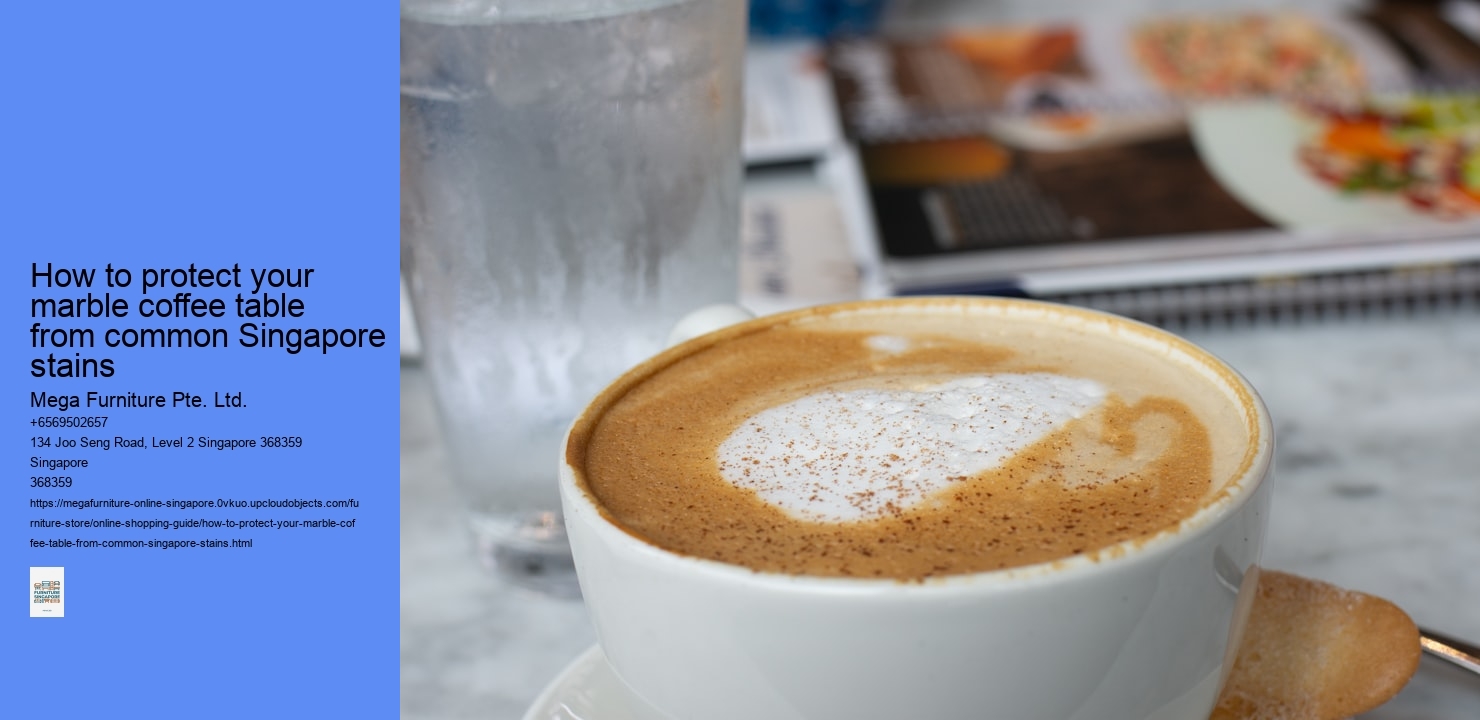
That morning condensation on a marble surface isn't just water—it’s the start of a watermark. Singapore’s ambient humidity, often above 80%, ensures that any cool surface becomes a magnet for moisture, and a polished marble coffee table is a prime target. This persistent dampness, coupled with frequent spills from iced drinks, accelerates the chemical reaction that etches the stone and leaves behind dull, pale spots; the polish acts as a sacrificial layer, and once it's gone, the damage is in the stone itself.
The local diet presents a more immediate threat. A stray splash of kopi-o, with its acidic tannins, can etch a polished marble finish in minutes if not wiped immediately. Laksa's citrusy lime juice or the juice from buah limau are equally potent. This reality makes marble a high-maintenance choice for a central living room fixture, where it’s expected to hold mugs, bowls, and the occasional plate of curry puffs during movie night.
Maintenance isn't optional—it's a weekly ritual. You’ll need a pH-neutral stone cleaner, never vinegar or generic sprays, and immediate blotting of any spill. Even then, a honed finish, which is matte and less slippery, hides etching better than a high-gloss polish, though it stains more easily from coloured liquids. Many homeowners who choose marble accept that professional sealing is a recurring cost, typically needed every 12 to 18 months in our climate, and that some patina from use is inevitable.
It’s a beautiful, cool-to-the-touch statement piece that carries the weight of geological time, but in a 4-room BTO living room, that history includes every spilled cordial and every humid afternoon. For those drawn to the look but wary of the upkeep, sintered stone or quartz composite slabs offer a convincing veined pattern without the reactivity.
The first time a guest leaves a sweating kopi-O glass on your new marble table, you’ll understand why sealing isn’t optional — it’s your only line of defence. In Singapore’s humidity, that condensation isn’t just water; it’s a slow acid bath waiting to etch the surface. The practical choice comes down to two main types of protectants: penetrating sealants that soak into the stone’s pores, and topical coatings that sit on top like a shield.
Penetrating sealants, often silicone- or fluoropolymer-based, are the preferred choice for most natural stone. They work invisibly, repelling liquids from within while letting the stone’s natural texture and colour show through. Topical coatings, like acrylics or waxes, create a more noticeable barrier; they can add a slight sheen but may feel plasticky and can wear unevenly with frequent wiping. For a busy living room centrepiece, the invisible, breathable protection of a good sealer is typically the smarter investment — a waxed surface will show every fingerprint and water ring.
Realism is key when planning reapplication. A salesman might promise five years, but in a typical 4-room BTO living room with daily use, wet coasters, and airborne kitchen grease, you should plan for a refresh every 18 to 24 months. The test is simple: sprinkle a few drops of water on the surface. If it beads up, your seal is intact; if it soaks in darkening the stone, it’s time for a fresh coat. Don’t wait for a stain to tell you.
The process itself is non-negotiable and must be done before the table sees its first magazine or remote control. Clean the stone thoroughly with a pH-neutral cleaner to remove any factory residue, allow it to dry completely in our humid air — which can take a full day — then apply the sealer evenly with a soft cloth. It’s a tedious Saturday afternoon task, but it’s cheaper than professional stain removal later. Remember, no sealant is a force field; it only buys you critical minutes to wipe up spills before they become permanent.
Act instantly when a spill occurs. Blot—never wipe—the liquid with a soft, absorbent cloth to prevent it from seeping into the stone. For sticky substances, use a plastic scraper to gently lift the bulk material before cleaning.
For daily cleaning and after addressing spills, only use a cleaner specifically formulated for natural stone. These pH-neutral solutions effectively remove residues without etching or damaging the marble's delicate surface. Always apply with a soft microfiber cloth.
Singapore's high humidity can cause condensation, leading to permanent cloudy rings. Always use coasters with a solid, dry base for all drinks. Wipe the table surface with a dry cloth regularly to manage ambient moisture.
Every glass, mug, or tumbler needs a physical barrier. Condensation from chilled drinks is the primary culprit, forming a persistent wet ring that etches into the polish. A good coaster isn't just cork or felt — it's a raised-edge silicone mat that contains the entire puddle. Skipping this for a quick phone charge or to place a book is precisely how those ghostly white rings appear. In Singapore's humidity, that moisture doesn't evaporate; it soaks in.
Confine clutter to a dedicated serving tray. This ritual isn't about formality, but about creating a predictable, cleanable zone for remotes, snack bowls, and decorative objects. A large, handled tray made of lacquered wood or sealed ceramic becomes the sacrificial surface, catching crumbs and minor scratches instead of the marble. It also simplifies your weekly dusting routine, as you can lift the entire arrangement off in one go. Think of it as a mobile landing pad for daily living.
Immediate blotting is non-negotiable. The instinct to wipe a spilled teh-o or kopi across the surface is the worst thing you can do, as it grinds particles in and spreads the stain. Instead, gently place a clean, absorbent cloth over the spill and press down — don't rub. Repeat with a fresh section of cloth until no more liquid transfers. For oily residues, a second pass with a damp cloth follows, but only after the initial spill is fully absorbed. Speed here matters more than the cleaner you use.
Weekly dusting demands a pH-neutral cleaner designed for natural stone. Common multi-surface sprays often contain acids or alkalis that degrade the protective seal over time, leaving the marble porous. A simple, dedicated stone cleaner diluted in water is sufficient; avoid vinegar, lemon juice, or abrasive scrubs entirely. Mist the solution lightly onto a microfibre cloth, not directly onto the table, to prevent pooling. This preserves the seal, which is your main defence against staining in the first place.
Define eating areas with oversized, wipeable placemats. In many 4-room BTO layouts, the coffee table doubles as a casual dining spot, facing significant risk from curry or soy sauce. A large rectangular placemat establishes a clear boundary for plates and bowls, far more effectively than a coaster. Opt for a material like laminated cotton or PVC-backed fabric that can be wiped down immediately after use. It’s a simple, visual cue that transforms a centrepiece back into a functional surface for mealtime.
A marble coffee table's worst enemy isn't a stray elbow or a dropped remote; it's a Friday night takeaway session that goes slightly awry. The real test of a centrepiece material happens when kopi drips, chilli sauce splatters, or curry oil pools — Singaporean stains that require a localised, immediate response.
For a fresh kopi spill, your first move is to blot, not wipe, with a clean microfiber cloth. Follow with a gentle wash using a few drops of pH-neutral dish soap in a bowl of distilled water; tap water's minerals can leave their own dulling film if not dried perfectly. A dried coffee ring often needs a poultice — a paste of baking soda and distilled water left under cling film overnight to draw the tannin stain up and out.
Keep a dedicated stain kit in the kitchen cabinet: a spray bottle of distilled water, a box of baking soda, a roll of cling film, and several clean microfiber cloths. The goal is to act before a spill dries and sets — that thirty-second pause to fetch supplies is always worth it. For deeper, set-in stains you can't shift, a professional stone restorer's contact is the next step; they can often perform a localised polish on a single spot, avoiding a full-table refinish.
Curry oil and chilli sauce demand a two-step attack. First, absorb any excess oil with cornstarch or baking soda, letting it sit for fifteen minutes. After brushing it away, tackle any remaining turmeric or chilli pigment with that same baking soda poultice method; the alkaline paste works on organic stains without the etching risk of vinegar or lemon juice. Soap scum from wet glasses or a hurried wipe-down is simpler: a damp cloth with a sprinkle of baking soda, buffed in a circular motion, will lift the filmy residue without abrasion.
Remember, the patina on a marble table tells the story of a home lived in — a few faint, properly treated marks are preferable to the dull, etched surface left by panic-cleaning with the wrong agent.
" width="100%" height="480">How to protect your marble coffee table from common Singapore stains

Walking into a typical HDB living room, you’ll find the coffee table is often the first surface to bear the brunt of daily life — a spilled kopi, a forgotten bowl of curry, or a child’s sticky fingerprints. That’s why many buyers hesitate; they love marble’s cool, polished elegance but fear it’s a fragile museum piece, not a family-friendly centrepiece. What changes that perception is seeing a sealed, ready-for-use table in a realistic setting, not just as a solitary item on a warehouse floor. At Megafurniture’s Joo Seng and Tampines showrooms, their marble selections are displayed in complete room sets scaled to 12–16 sqm spaces, which mirrors the exact dimensions of many condo living areas or renovated HDB layouts. You can immediately gauge how a 120cm rectangular table fits with your sofa, or if an oval design better navigates a tight walkway. The practical advantage here is that the marble is already professionally sealed upon display. This isn’t a vague promise; staff actively demonstrate maintenance using local stain agents like soy sauce or teh tarich, showing how a quick wipe with the provided pH-neutral cleaner handles most spills. It turns an abstract worry into a manageable routine. For the design-conscious shopper replacing an outdated table, this tangible reassurance matters more than a sales brochure — they can visualise the stone not as a liability, but as a durable, beautiful anchor for their refreshed space. Material choice in Singapore often boils down to balancing aspiration with pragmatism. Marble offers that statement centrepiece weight, a natural coolness under the palm, and a unique veining pattern that engineered stones or laminates simply can’t replicate. In a market where many compact living rooms rely on visual tricks to feel larger, a substantial marble table can actually ground the space, organising the visual clutter around a solid, defined centre. The showroom setups prove that; they pair these tables with storage consoles and media units, showing how the material can anchor a cohesive scheme without dominating it. Ultimately, selecting a marble coffee table here isn’t about indulging in a luxury material, but about solving a specific local problem: wanting a lasting, elegant focal point that withstands humid, high-use environments. Seeing the finished, maintained product in a relatable room context bridges the gap between desire and daily reality. You can
browse their marble optionsonline, but the real confidence comes from visiting and seeing that the sealed surface repels a demonstration spill — a simple test that often decides the purchase.
The marble slab for your new coffee table arrives at your doorstep in a crate, and that's when the real work begins. Navigating a 1.2-metre-wide HDB lift landing with a 1.5-metre-long pallet is a common Singaporean puzzle; delivery crews are practised in the pivot-and-tilt manoeuvre required for narrow condo corridors, but buyer oversight helps. You'll want to clear the path from the lift lobby to your unit — that decorative ceramic pot from Chinatown is a genuine hazard.
Before signing the delivery note, verify the slab thickness. A 20mm-thick marble top feels substantial, while a 15mm one can seem disappointingly slight; the paperwork should specify this, and it's a quick check with a tape measure before the crew leaves. This is also the moment to inspect for transit damage along the edges or veining, as post-delivery claims get complicated.
Assembly for a marble table is typically straightforward, often just attaching pre-drilled metal legs to a predrilled stone top with provided bolts. The real weight means you'll need two people to flip it over safely — doing it alone on a polished porcelain floor is a recipe for a chipped corner and a strained back.
Local warranty terms for natural stone often come with significant caveats. Most explicitly exclude 'wear and tear', which covers everything from the inevitable etching from a spilled lime juice to fine hairline scratches from daily use. The warranty usually only addresses structural failure, like a leg detaching or a slab cracking clean through. That beautiful, porous surface is yours to maintain; the protection plan effectively ends once the delivery truck drives off.
Consider a marble table a long-term commitment, not a disposable piece. Its character will evolve with every ring from a cold glass, a reality better accepted before purchase than fought after.
The best questions about coffee tables aren’t about style—they’re about what happens when life, and a toddler’s sippy cup, inevitably collide. We collected the real ones homeowners ask after the new table arrives.
Can I use lemon to clean? No. It’s a classic hack for sinks, but lemon juice is acidic and will etch marble’s polished surface, leaving dull spots. For daily cleaning, a pH-neutral stone cleaner and a soft microfibre cloth are the only safe bets.
Water rings after one week—faulty table? Not necessarily. A quality sealant should repel spills, but a ring that appears after a week suggests the seal wasn’t applied perfectly or has worn thin already. In our humid climate, it’s wise to test the seal on delivery; if water doesn’t bead, you might need a professional re-seal sooner than expected.
Marble versus sintered stone for pets? For claws and accidents, sintered stone wins. It’s non-porous, so paw prints and the occasional spilled water bowl wipe right off without staining. Marble requires more vigilance—a single scratch from a dropped toy is permanent, and you’ll be resealing it annually to guard against pet-related moisture.
Cost to professionally polish in Punggol? For a standard 120cm marble table, you’re looking at around $180 to $350. The price hinges on the damage; light cloudiness from etching is cheaper, while deep scratches need more intensive grinding. Get a technician to assess it—many Punggol condo dwellers book this service every two to three years to keep that glossy centrepiece looking new.
A marble coffee table, freshly unwrapped in a Tampines condo, often becomes a household’s most guarded possession. That initial gleam feels like a promise—until the first coffee ring appears, a permanent souvenir from a Saturday breakfast. The real choice isn’t just between materials; it’s about what kind of domestic life you’re signing up for.
Households with young children or a schedule packed with gatherings might find the commitment jarring. Sintered stone offers a compelling alternative here, mimicking marble’s veined drama without the panic over red wine or turmeric stains. Its non-porous surface handles spills from playdates and cocktail hours with equal indifference, which in many homes isn’t just a convenience—it’s a mental reprieve. You’re buying a centrepiece, not a liability.
So, does your current phase justify the upkeep? If you’re in the midst of a full living room refresh, replacing worn laminate or scratched wood, the calculus changes. This is the moment to align your furniture with your actual routines, not an aspirational version of them. A homeowner in a 4-room BTO, finally upgrading from a temporary Ikea piece, might decide the marble’s beauty is worth the ritual of coasters and immediate wiping. Another, in a landed home where the living room doubles as an everyday family hub, could logically conclude it isn’t.
Postponement is a valid strategy, too. There’s little sense in straining a renovation budget for a material that will cause daily stress. Opting for a durable, neutral solid wood table now creates a functional anchor; you can always circle back to marble for a side table or console later, when the toddler phase has passed. The decision often hinges on whether you see maintenance as a mindful practice or a persistent chore.
Ultimately, your coffee table should serve your life, not dictate it. Browse the options with that principle in mind.