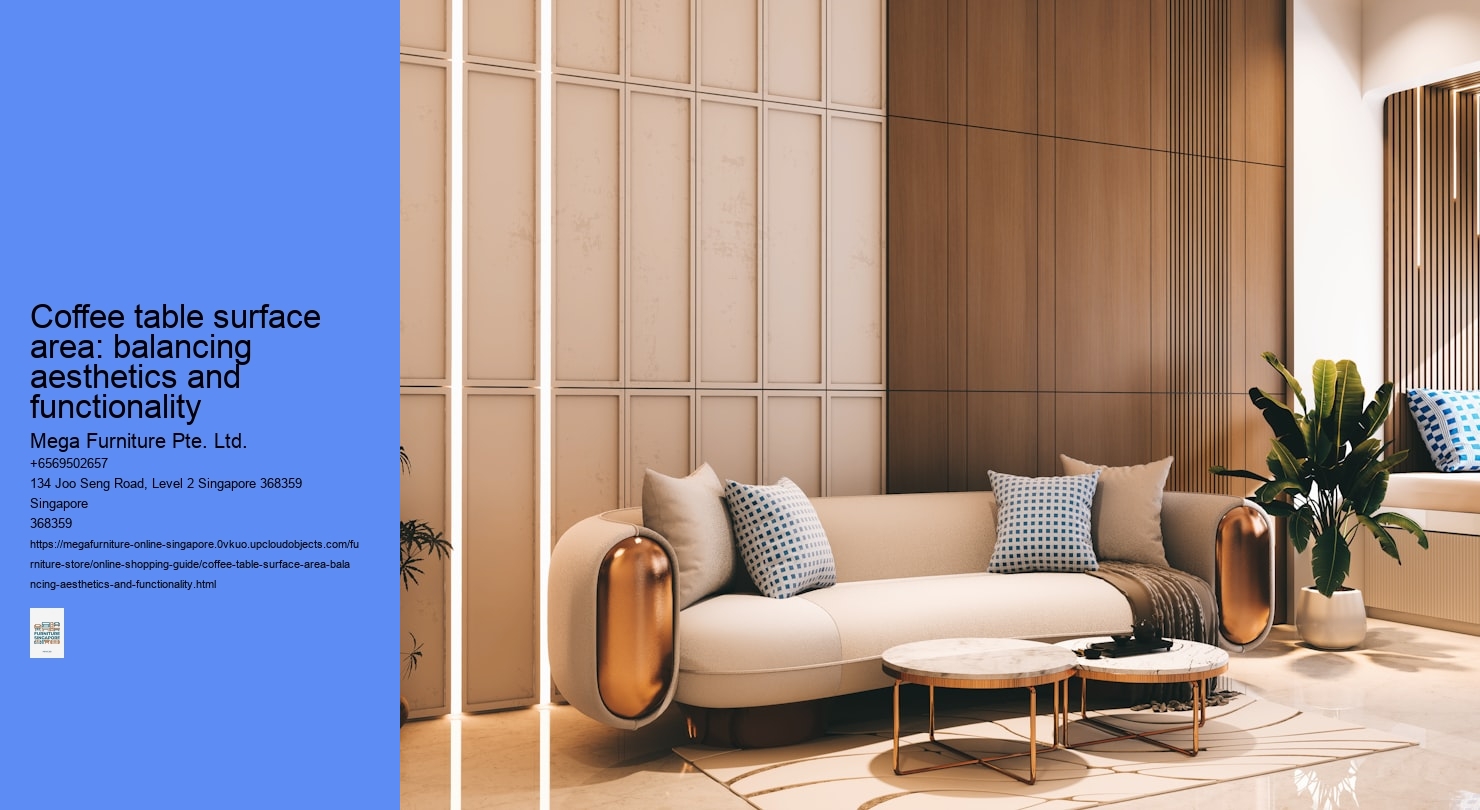
Walk into a 4-room BTO flat in Punggol and the living room's main artery is often a single, narrow path from the entrance to the bedrooms — a coffee table that's too large becomes a daily shin hazard. The table's surface area here isn't about grandeur; it's about leaving enough clear floor for a pram to pass or for guests to navigate to the dining area without a detour. A rectangular table around 90cm long, tucked close to the three-seater sofa, typically works — it provides a landing spot for drinks without claiming the entire 12 sqm floor. Resale apartments in older estates like Bedok or Queenstown present a different puzzle. Their living rooms are often more generously proportioned, but the flow can be irregular, with columns or odd nooks breaking up the space. A larger oval or round table, perhaps 110cm in diameter, can soften these awkward corners and create a natural centre for seating that's been arranged around the room's peculiarities. The key is to measure not just the room's dimensions, but the primary walking routes that have been established over decades of use — that's where you'll need to keep a 60cm clearance, minimum. Condo open-plan layouts, especially in newer developments, demand a different calculus altogether. With the living area flowing uninterrupted into the dining space and often the kitchen, the coffee table becomes a visual anchor, not just a functional one. Marble Coffee Table . In a 40 sqm combined area, a low-slung, sculptural table in sintered stone or solid wood can define the lounge zone without blocking sightlines. You can afford a 150cm length here, but its height should stay below 40cm to maintain that sense of airy openness. Material choices follow suit. For the BTO's high-traffic lane, a rounded-edge rubberwood or a metal-framed table withstands the occasional bump. The resale apartment might allow for a statement material like marble, while the condo's dust-prone open plan often sees buyers opting for easy-wipe sintered stone or tinted glass. It’s a quiet admission that in Singapore, your housing type dictates your housekeeping tolerance as much as your aesthetics. Ultimately, the right surface area is the one that leaves you room to live around it. Before you fall for a beautiful, sprawling design in a showroom, tape out its dimensions on your floor with newspaper and live with it for a day — you’ll quickly see if it interrupts the school bag drop-zone or the nightly path to the fridge. For a curated range of sizes and shapes suited to local floor plans,
browse the optionsand measure twice.
The 2.4-metre sofa is a standard in 4-room BTO layouts, and it often leaves a coffee table looking either comically small or overwhelmingly large. That’s where a simple proportion rule helps: aim for a tabletop length between 0.3 and 0.5 times your sofa’s length. For that 2.4-metre staple, you’re looking at a coffee table around 70 to 120 centimetres wide—a range that accommodates everything from a compact oval to a substantial rectangular piece.
This proportion isn’t arbitrary; it’s about functional surface within a tight space. A table at the lower end, say 70cm, leaves ample room for movement in a narrow living room, while a 120cm width provides generous landing space for trays and books. The key is to factor in walkway clearance, a non-negotiable in HDB layouts. You’ll need at least 60cm of clear passage between the table and the TV console or opposite seating—any less, and the room feels like a cluttered corridor.
Material choice interacts directly with this sizing logic. A bulky solid wood table at 120cm can dominate visually, whereas a glass-top design at the same dimensions feels lighter and preserves sightlines. In many compact condos around Tanah Merah or Bedok, a sintered stone top around 90cm long strikes a practical balance; it’s durable against condensation from glasses and doesn’t swallow the limited floor area.
Ultimately, the formula is a starting point, not a rigid rule. A homeowner with young children might opt for a smaller, round rubberwood table to minimise sharp corners, even if it’s slightly under-proportioned. Marble suits Singapore's tropical climate — the stone naturally pulls heat away on contact, giving the surface a perpetually cool feel that's especially welcome in air-conditioned living rooms. Megafurniture's Scandinavian Coffee Table range covers white-veined classics, black marble statement pieces, and round designs with brass or wooden bases. Natural-stone variation means each piece has unique veining — an authenticity advantage over engineered alternatives that try to replicate the look.. The goal is to find a centrepiece that serves daily life—holding your kopi, remotes, and the weekend newspaper—without turning your main thoroughfare into an obstacle course.
That beautiful teak or oak table will warp if you ignore Singapore's humidity. Solid wood requires a rigorous sealing regimen with oils or polyurethane, especially near windows or in ground-floor units where moisture ingress is higher. Many buyers don't realise that even a single spilled drink can leave a permanent ring if the sealant wears thin. It's a commitment—you'll need to reapply protective finishes every year or two, which becomes a chore. Yet, that maintenance is precisely what gives aged wood its character, developing a patina that synthetic materials can't replicate.
For households with kids or a habit of hosting, sintered stone's near-total stain resistance is a practical luxury. Coffee, red wine, and curry pose no threat to its non-porous surface, which won't etch or absorb liquids like natural stone might. It's also highly resistant to heat, so placing a hot kopi cup directly on it won't leave a mark. The material feels cool and substantial, lending a contemporary, high-end look that works in both condo and larger HDB layouts. Its main drawback is a clinical feel some find less inviting than wood, but for pure resilience, it's hard to beat.
In a narrow 4-room BTO living room, a glass tabletop can visually double the perceived space by allowing light to pass through. It creates an airy, unobtrusive centrepiece that doesn't crowd the sightlines in tighter layouts. Tempered glass is standard for safety, but it will show every fingerprint and water spot, demanding frequent wiping with a microfiber cloth. The clarity also means whatever you stash on the lower shelf—remote controls, magazines, toys—becomes part of the display, for better or worse. It's a trade-off: you gain light and a sense of space but commit to constant tidying.
Powder-coated steel or aluminium frames are the unsung heroes for homes with pets or active children. They resist scratches from claws or accidental bumps far better than any wood finish, maintaining their look for years. The powder coat also provides a barrier against rust, which is crucial in our coastal humidity, though cheaper painted finishes might still chip. These frames often support heavier stone or glass tops, offering a sturdy, industrial aesthetic that's become quite popular. They're a pragmatic choice that prioritises longevity over traditional warmth, often found in designs at Megafurniture's collection.
Laminated MDF or rubberwood veneers offer a middle path, with factory-applied seals that provide decent initial protection. They're more dimensionally stable than solid wood in humid conditions, so they're less likely to warp or crack in the first few years. The risk comes at the edges or corners; once that thin veneer chips, moisture can seep into the core and cause swelling. It's a cost-effective solution for a five-year refresh cycle, but don't expect it to last a decade in daily use. Furniture Singapore . You're buying time, not an heirloom, which suits many first-time homeowners in Punggol or Sengkang BTOs perfectly.
A common sight in a 4-room BTO living room: a massive rectangular coffee table that forces residents to sidestep its sharp corners on every trip to the balcony. Buyers often gravitate towards these oversized designs, misjudging how a 150cm length can dominate a 12 sqm space and leave barely 60cm for circulation. That's the first misstep—overestimating floor area and forgetting that a coffee table's footprint includes the clearance you need to walk around it comfortably.
Then there's the issue of containment. A perfectly flat, smooth surface of marble or glass might photograph well, but it's a disaster waiting to happen for a cold drink on a humid afternoon. Scandinavian coffee tables lean on Nordic design principles — clean lines, neutral palettes, light wood finishes, and natural upholstery materials around the broader living-room context. Megafurniture's Online Furniture Singapore range features oak and walnut with MDF veneer finishes, sized for compact HDB and condominium living rooms. The pieces pair especially well with light-wood floors and white-walled interior schemes.. Neglecting tray functionality, or a slight lip at the edge, means every condensation ring is a direct threat to the finish and your peace of mind. A sintered stone top with a subtle raised border, or simply committing to use a dedicated tray, solves this—prioritising lived-in functionality over a sterile, magazine-perfect look.
The second mistake is less obvious until you sit down. Low-profile tables, especially those under 40cm in height, can look sleek in a showroom but create a frustrating experience in use. You'll find yourself hunching awkwardly to reach a drink, and the lack of leg clearance becomes painfully apparent when you try to stretch out after a long day. In many homes, the ideal height sits around 42-45cm, roughly level with the sofa seat cushions—this isn't just aesthetics, it's basic ergonomics for a space meant for relaxation.
Material choice compounds these errors. A heavy solid wood rectangle becomes an immovable obstacle during festive gatherings or when you need to vacuum underneath. A lighter engineered wood or metal-framed oval table, perhaps with a shelf below, offers far more flexibility for the dynamic way compact spaces are used. It’s about finding a centrepiece that accommodates daily life, not one that dictates it.
Ultimately, the best coffee table for a compact home often isn't the one that makes the boldest statement in isolation. It's the one that disappears into the rhythm of the room, offering a practical surface without demanding constant negotiation.




A coffee table’s first impression often comes from across the room—its silhouette, its colour. The real test, however, happens within arm’s reach, where the details of its construction either reassure or disappoint. This close inspection is where you separate a lasting centrepiece from a future annoyance.
Start with the fundamentals. Run a hand along every joint; in a solid wood or engineered wood frame, there shouldn’t be any perceptible gaps or wobble. Check the finish under natural light—in a north-facing Bedok condo or a sunlit Tampines HDB living room—for uneven staining or blotchy patches. A well-made table also feels stable; lift one corner slightly to gauge its heft and balance, as a table that’s too light or rocks easily won’t survive daily life.
Material-specific signals are equally telling. For engineered wood, examine the edges and corners; a quality piece will have a thick, properly adhered veneer that wraps seamlessly, with no chipping or visible layers of substrate. A cheap one often betrays itself with a thin, peeling edge tape. For stone tops, whether marble or sintered stone, look for consistency in the veining or patterning across the entire slab—abrupt changes or glued-town sections suggest lower-grade material.
Don’t ignore the underside. It’s a favourite hiding spot for poor workmanship: unfinished edges, hastily applied sealants, or flimsy hardware. That’s where you’ll often find the real story of how a piece was put together. A clean, well-finished underside isn’t just about aesthetics; it’s a reliable indicator of overall care in construction.
For a practical range that spans these material and construction considerations, from solid rubberwood to sintered stone, you can browse the options at Megafurniture’s collection. Ultimately, this quiet evaluation is what ensures your chosen table won’t just look good on day one, but will still feel solid years later when a toddler uses it as a launchpad or a guest sets down a sweating glass.
A common regret among coffee table buyers is discovering that a piece feels too insubstantial or visually overwhelming only after it’s been delivered to their four-room BTO. Online furniture shopping has overtaken showroom-only buying for most Singapore renovators — flat-screen specifications, multi-angle photography, and customer reviews give buyers more decision-support online than in-person browsing typically provides. Megafurniture's Living Room Furniture catalogue brings the full house in one place, from sofas and TV consoles through to bed frames, mattresses, dining sets, and wardrobes. The 0% interest pay-later option helps spread larger purchases across multiple months.. Online photos can’t convey the heft of a solid rubberwood slab or the precise coolness of a sintered stone surface. That’s where a physical showroom visit proves its value—you’re not just looking at dimensions on a screen, you’re assessing presence in a room.
At Megafurniture’s Tampines and Joo Seng locations, entire living room vignettes are set up with sofas and media consoles. This lets you judge proportion immediately: will that 150cm rectangular table dominate your narrow layout, or does an oval design better facilitate flow? You can test stability by pressing down on a corner, a simple check for wobbly legs that online reviews often miss. More importantly, you can run a hand across the finish—the smooth lacquer on an engineered wood piece, the honed texture of marble, the reassuring solidity of a welded metal frame.
Tactile assessment matters for daily use. A glass top might look sleek in a gallery shot, but in a household with young children, its propensity for showing fingerprints becomes a constant chore. A rough-hewn live edge table could snag delicate fabrics. In the showroom, you’ll notice these details firsthand; you might find that a satin-finish oak feels warmer and more forgiving than the high-gloss walnut you initially favoured.
Ultimately, a coffee table is a functional centrepiece you interact with daily. Seeing it in a mocked-up space confirms whether its 42cm height aligns comfortably with your sofa’s seat depth, or if a lower profile would look awkward. It’s the difference between buying a piece of furniture and investing in one that genuinely fits your life—which is why a trip to browse the options in person is often the most practical step in the selection process.
The delivery crew will likely ask you to meet them at the void deck. That’s standard for most HDB deliveries, but it’s worth confirming whether the service includes stair-climbing to your unit — especially if you’re in a resale block without lift access on every floor. A solid wood or sintered stone coffee table can be a two-person job up three flights of stairs, and you don’t want that surprise on delivery day.
Once it’s in your living room, don’t assume it’s perfectly level. Floors in older HDB flats and condos can have subtle slopes; a wobbly table is an annoyance you’ll notice every time you put down a drink. Ask the assemblers if they can perform on-site levelling adjustments. Many will have shims or adjustable feet to stabilise the piece, which is a far better solution than wedging a coaster under one leg for the next five years.
For warranty, look beyond the standard one-year coverage for manufacturing defects. The real test for a coffee table in Singapore isn’t structural failure — it’s the climate. A good warranty should explicitly address humidity-induced warping or cracking in solid wood, or de-lamination in engineered wood veneers. That’s the coverage that actually matters when your table lives in a 75% humidity environment year-round.
It’s a detail often overlooked in the showroom, but a warranty that acknowledges local conditions suggests the retailer has confidence in their material sourcing and treatment. You can browse options with clear terms at Megafurniture’s collection.
For peace of mind, keep the table away from direct air-con blasts and afternoon sun from your west-facing window — no warranty will cover damage from extreme, direct exposure. But for the general dampness that seeps into every flat in Bedok or Bishan, your warranty should have you covered.
The square coffee table offers a generous, stable surface area, ideal for anchoring a seating arrangement. Its equal sides provide functional symmetry, allowing easy access from multiple sides for placing drinks or books. This shape maximizes usable space within a compact footprint, blending substantial utility with a clean, modern aesthetic. Its straightforward geometry makes it a versatile choice for both contemporary and traditional living spaces.
A rectangular coffee table provides an elongated surface, perfect for accommodating more guests or displaying decorative trays and items in a line. This shape naturally complements sectional sofas or longer sofas, enhancing the room's flow and functionality. The extended area allows for distinct zones, such as one end for remotes and the other for a centerpiece, without appearing cluttered. Its classic proportions lend a sense of order and spaciousness to the living area.
A round coffee table introduces softness and promotes easier circulation, as its lack of sharp corners creates a safer, more navigable space. The circular surface area encourages social interaction by allowing everyone seated around it an equal visual and physical connection. While offering ample room for essentials, its shape inherently feels less imposing, making it excellent for smaller rooms. This style balances a friendly, inviting aesthetic with practical, space-efficient functionality.
An oval coffee table merges the generous surface of a rectangle with the softened, fluid lines of a circle. It provides a substantial usable area that guides movement around its curved perimeter, enhancing traffic flow in a room. The elongated yet rounded form is both aesthetically graceful and functionally versatile, suitable for creating a focal point. This shape effectively balances ample display and utility space with an elegant, approachable design.
The most common coffee table question isn't about style or material — it's the buyer staring at a 45cm-high table next to their 42cm-high sofa seat, wondering why the whole arrangement feels just a bit off.
For a standard sofa seat height around 40–45cm, you’ll want a table surface roughly 5cm lower. That’s the sweet spot for reaching a cup without hunching. In a 4-room BTO living room, a 120cm-long rectangular table often fits the scale, but an 80cm-diameter round one can improve circulation. It’s a game of centimetres.
Marble is a statement, but Singapore’s humidity is its nemesis. Untreated, it’ll etch from acidic spills and lose its polish. You’re committing to quarterly sealing with a proper impregnator; a sintered stone or engineered quartz lookalike sidesteps that maintenance entirely, which is why many buyers opt for it. Oval tables are the quiet solution for square rooms. Their curved edges soften the geometry and improve foot traffic around a typical 3.5m x 3.5m space, avoiding the shin-banging corners of a rectangle.
Finally, the classic BTO living room proportion — often a long, narrow 3m x 4.5m layout — demands careful furniture scaling. A table that’s too large blocks the walkway to the balcony; one that’s too small looks lost. Leave about 60cm between the sofa edge and table for legroom, and ensure there’s still a clear 90cm pathway behind it. That balance is more functional than any trend.
That living room floor plan you sketched on your phone six weeks ago? It’s probably wrong now. The most common mistake isn’t picking the wrong shape or material; it’s ordering a table based on old measurements taken before the rug arrived or the sofa was finally delivered. You need a final, physical audit. Lay your existing rug down and mark the expected leg positions of your new coffee table with masking tape. This visualises the footprint in real space, showing you if a round table will clear the sofa’s chaise or if a rectangular one will leave enough walkway to the balcony door. In many 4-room BTO layouts, an extra 10cm overhang can mean the difference between a clear path and a constant shin hazard. Then, verify the height against your actual sofa seat. A common mismatch happens with lower-profile modern sofas; a standard 45cm-high table can feel awkwardly tall, forcing you to reach up for your drink. Conversely, a very low, sculptural piece might look stunning but turn retrieving a magazine into a chore. Don’t forget remote controls—if you’re considering a solid-sided design or a table with a deep lower shelf, test whether your handset can be accessed from your favourite seat without contortions. This final check also reveals practical quirks. A sintered stone top might reflect glare from your floor lamp directly onto the TV screen, or the ornate metal base of that statement piece could catch on your vacuum cleaner head. It’s these small, lived-in details that a showroom visit can’t simulate. Ultimately, the right table feels settled the moment you place it. You’ll know because nothing needs to be shuffled, and the remote stays put. For a wide range of sizes and shapes that can meet these precise needs, from compact oval designs for narrow spaces to larger rectangular pieces in solid wood, browse the
coffee table collectionto match your final specifications.